- Past event
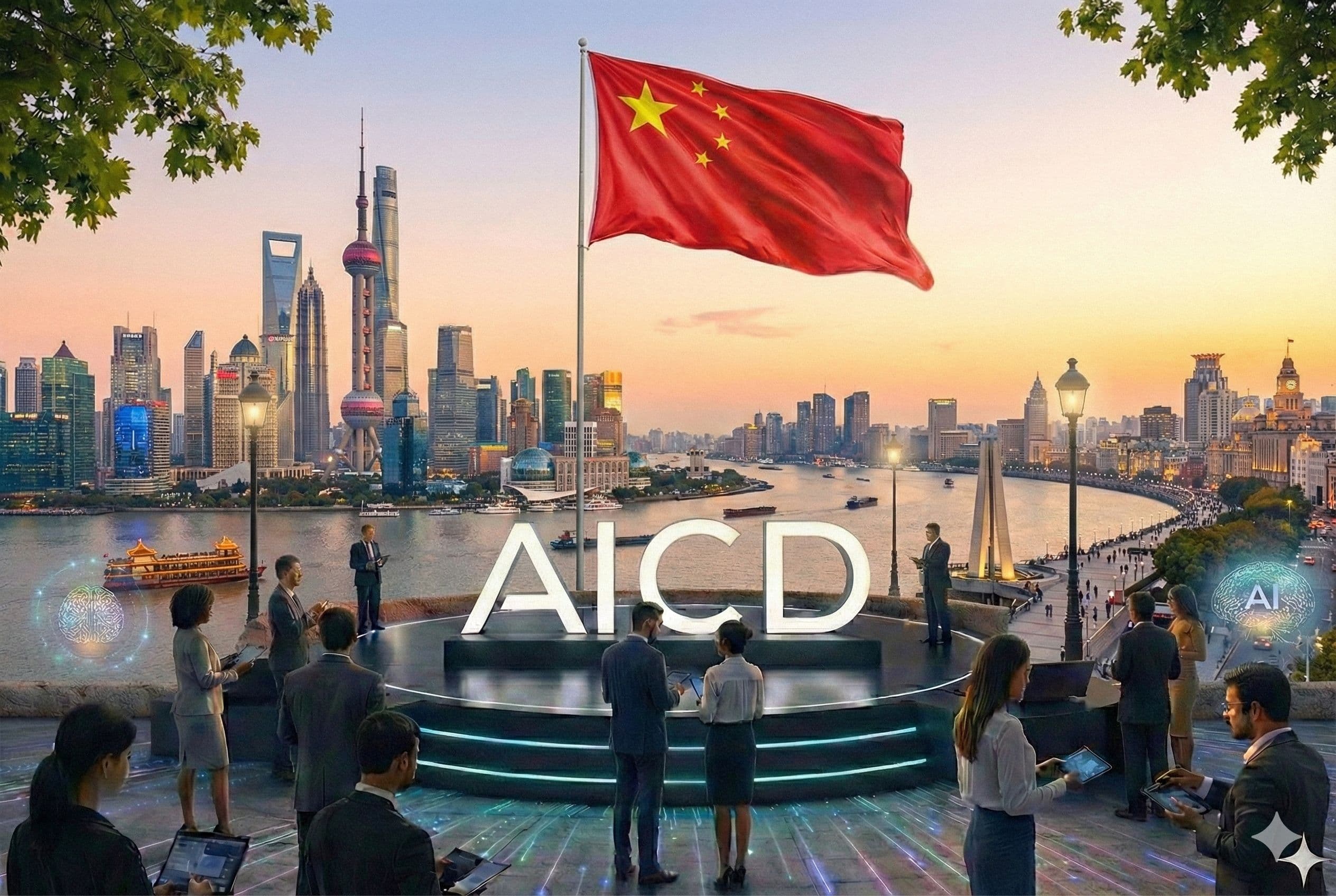
AI Community Day Shanghai
Shanghai, China · In person
21 March 2026
Saturday
01:00–10:00 local time (GMT+8)
Building C9, No. 77 Hongcao Road, Xuhui District, Shanghai







This event took place on Saturday 21 March 2026.
Shanghai, China · In person
21 March 2026
Saturday
01:00–10:00 local time (GMT+8)
Building C9, No. 77 Hongcao Road, Xuhui District, Shanghai
This event took place on Saturday 21 March 2026.
AI Community Days Shanghai at Microsoft China - Join the largest AI community event in China!
Times in Shanghai time (GMT+8)
9:00 AM
9:30 AM
10:00 AM
10:45 AM
11:40 AM
12:45 PM
1:30 PM
2:15 PM
Times in Shanghai time (GMT+8)
As AI technologies evolve at unprecedented speed, organizations across the world face a similar challenge: technology moves faster than culture, structure, and leadership habits can adapt. The real differentiator in successful AI adoption is not technical sophistication, it is leadership communication. In both Western and Asian business environments, expectations toward leadership differ, yet one principle remains universal. Trust determines whether AI initiatives are embraced or resisted. This session provides executives, innovators, and decision-makers with a structured framework to communicate AI with clarity, responsibility, and cultural awareness. Participants will explore: How to translate AI use cases and LLM integration into messages that create alignment across diverse teams How to embed Responsible AI principles into leadership communication, beyond compliance and policy How to manage uncertainty and reduce resistance while respecting different cultural expectations around authority and transparency How leaders can strengthen their credibility and visibility in times of rapid technological change By connecting technological innovation with human-centered and culturally aware leadership, this session enables leaders and teams to implement AI in a way that is transparent, responsible, and sustainable across global markets.
Everyone thinks they need AI. Everyone is buying AI. Very few are getting real value from it. Why? Because companies are adapting their business to AI instead of making AI work for their business. They roll out 5,000 Copilot licenses or slap a chat interface on their intranet and call it a strategy. But AI is a tool, and like any tool, you need the right use case first, not the other way around. In this session, I'll walk you through the three AI archetypes: Embedded AI, GenAI and Agentic AI. Drawing from years leading AI projects at VC-backed startups and DAX40 corporates, I'll show you real-life use cases, what worked for each archetype, what failed and why. Instead of another high-level overview of models, we break AI initiatives down by business-case types and tie each one to concrete examples from more than 20 client projects. You'll see that not every business needs AI. But every AI initiative needs a solid business case and a real problem to solve. By the end, you'll know where AI genuinely helps and which factors determine whether an idea even qualifies as a use case. We'll close with a step-by-step method to identify and validate AI opportunities in your organization so they come with a clear business case from day one.
Discover how Large Language Models (LLMs) can expand the range of tasks you can automate using Power Automate, from triaging emails to processing unstructured data and generating content on demand. In this practical session, you will learn what AI Builder is, where it works well, and why it can be limiting in cost, flexibility, and control. We will compare it to Azure OpenAI, showing how calling GPT models via APIs gives you more transparency, better results, and often much lower costs, while giving you full control over how your AI works. You will also learn the basics of prompt engineering, including proven techniques for getting more reliable and accurate outputs. We will wrap up with live demos of real-world use cases such as email triage, text classification, and AI-driven content creation, so you leave with ideas you can start applying right away.
As Copilot Agents become central to enterprise workflows, prompt engineering is the key skill that separates helpful assistants from frustrating bots. This session dives deep into how Copilot Agents interpret prompts during a session, how to guide responses reliably, and how to design prompts that trigger the right actions at the right time.
AI agents are only as effective as the knowledge layer that supports them and building that layer requires more than theory. In this session, we dive into the technical foundations that make enterprise content usable for AI‑driven experiences. You’ll explore how knowledge is stored, structured, and accessed across SharePoint sites, OneDrive, and SharePoint Embedded containers, and what those choices mean for authentication, permissions, compliance, performance, and scale. We’ll walk through practical patterns for content modeling, metadata design, and retrieval optimization that improve grounding quality and response relevance. You’ll also learn how these content sources integrate with Copilot Studio, including how agents ground answers, respect security trimming, and orchestrate workflows across Microsoft 365 services. Through live demos, we’ll showcase SharePoint Embedded containers in real-world implementations and highlight tuning, governance, and operational strategies you can apply immediately when building secure, scalable AI‑native solutions. Who should attend: Developers, solution architects, and ISVs designing AI agents and copilots on top of Microsoft 365 content services.
AI in healthcare is shifting from the question of “can it work?” to “will it be correct?”. This session explores designing LLM-based systems as AI co-pilots rather than replacements, with a focus on reliability, human-in-the-loop controls, and compliance-first architectures. Drawing from real-world production experience, the talk covers prompt pipelines, orchestration patterns, latency and cost trade-offs, and strategies to detect and handle hallucinations. Attendees will learn practical techniques to build agentic AI workflows that remain accurate, trustworthy, and useful in high-stakes environments, even when models fail.
Picture this: you want to evolve from single-agent chatbots to complex multi-agent systems that must operate at production scale. However, building these systems presents critical challenges: how do you orchestrate agents built with different frameworks? How do you ensure reliable communication across programming languages and cloud providers? How do you scale beyond proof-of-concept to production-ready deployments? This hands-on workshop addresses these challenges through a realistic enterprise scenario, demonstrating the foundational pillars for production-ready agentic systems: framework-agnostic agent orchestration, event-driven communication patterns, and scalable distributed architectures. You'll build a working multi-agent system that showcases interoperability across the modern agentic frameowkrs. We'll integrate agents built with LangChain, LangGraph, and Google ADK, connect them through standardized protocols including A2A and MCP, and orchestrate the entire system using event-driven architecture principles proviuded by Agent Mesh. Rather than betting on a single framework or cloud provider, you'll learn architectural patterns that work across the polyglot reality of modern enterprise development. We'll explore how asynchronous messaging, event streaming, and publish-subscribe patterns solve the fundamental challenges of agent coordination: handling variable latency, managing failures gracefully, enabling dynamic discovery, and scaling individual agents independently.
Generative AI adoption has rapidly moved from experimentation to real-world implementation. However, many teams struggle to take GenAI solutions from proof-of-concept to secure, scalable, and governed production systems. This session provides a deep, practical walkthrough of Azure AI Foundry, Microsoft’s unified platform for building, evaluating, deploying, and governing enterprise-grade Generative AI solutions. The session focuses on how organizations can design end-to-end GenAI systems, select and orchestrate models, integrate enterprise data, apply responsible AI principles, and deploy solutions with confidence — all using Azure AI Foundry. Through real-world architecture explanations and a live demo, attendees will gain clarity on how Azure AI Foundry simplifies the complete GenAI lifecycle while ensuring compliance, security, and operational excellence.
8 speakers shared what they know.

Leadership & Communication Expert | Personal Branding Strategist | Crisis Communication Specialist
Spoke in Shanghai
Certified Data Analyst | Power Platform Developer | Content Creator | User Group Co-Lead
Spoke in Shanghai
AI Automations & Agentic Solutions Architect | Digital Transformation Leader | Enterprise AI & Data Strategy | Power Platform & Fabric Architect | Program & Delivery Management | Cloud Modernization M
Spoke in Shanghai
Senior Developer Advocate | Microsoft MVP Microsoft 365 & SharePoint | International Speaker | Community Leader | Product Evangelist
Spoke in Shanghai
Founder & Principal Consultant
Spoke in Shanghai
Software Engineer - Allminds
Spoke in Shanghai
AI Developer Advocate in an event driven world 🥑
Spoke in Shanghai
Microsoft Azure Developer Lead Surat Chapter | Microsoft Certified: Fabric Analytics Engineer Associate | Transforming Ideas into Digital Success using AI & Cloud
Spoke in ShanghaiEvery AI Community Day is run by volunteers from its city, with help from the global team.
The organizers of AI Community Day Shanghai appear here once they confirm their place on the event.
Run the next one in ShanghaiThe people who run AI Community Days around the world.
CEO · Cloud and Security Architect

Cloud and AI Engineer · Tech Trainer · Tech HealthCare Expert · Women in Tech Advocate

Chief Information Security Officer at FORTEIA

AI, Microsoft 365 and Power Platform Architect · MCT and MVP · Trainer · Speaker

Founder & Independent Technical Consultant · Microsoft Certified Trainer (MCT) · Power Platform, M365, AI & Copilot

Solution Architect on Microsoft Dynamics & AI
The recap
This event took place on Saturday 21 March 2026. Thank you to everyone who came, spoke, sponsored and volunteered.
8
speakers took the stage
8
sessions on the agenda
Every certificate has a unique code. Anyone can check that it is genuine on our verification page, and you can add it to your LinkedIn profile from your account.
Raise your hand to attend, speak, sponsor or help organize the next edition. The cities with the most interest get their date first.
Partners
We work with them at every AI Community Days event, in every city.
Upcoming events
Nov 24–25
.NET Africa Conference 2026