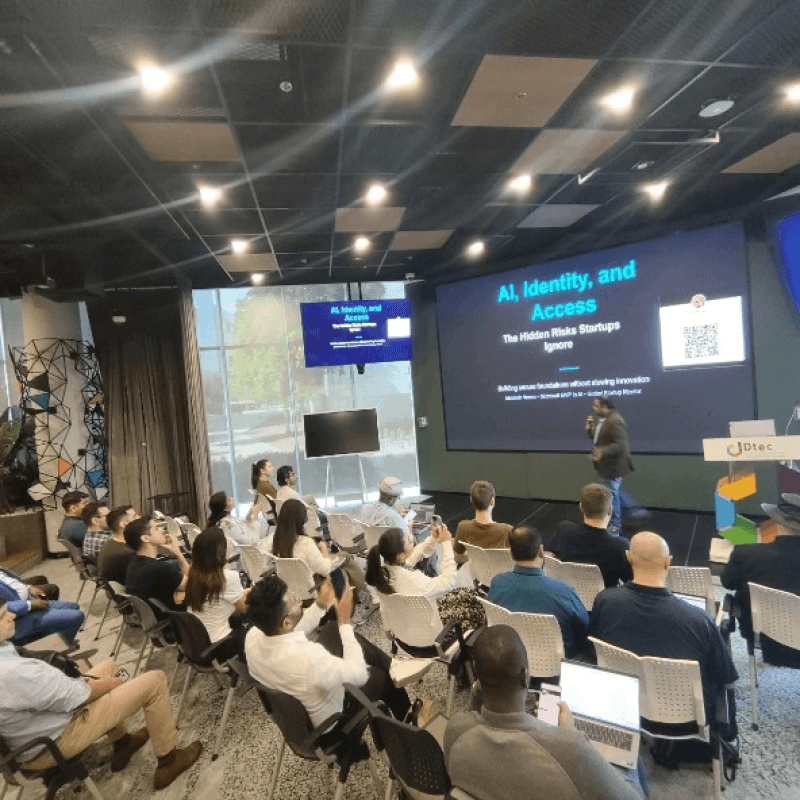
🌐 AI Community Days (AICD): A Global Movement for AI Knowledge Sharing
AI Community Days (AICD) is more than a conference it’s a worldwide initiative to democratize Artificial Intelligence and make innovation accessible to everyone.
What Makes AICD Unique?
Community-Driven: Organized by passionate AI professionals, developers, and enthusiasts not corporations.
Global Reach: Events in 30+ major cities across every continent, including San Francisco, Tokyo, Bengaluru, London, Paris, Frankfurt, Dubai, New York, Toronto, São Paulo, Seoul, Sydney, and Riyadh.
Inclusive & Ethical: Focused on responsible AI, diversity, and empowering local communities.
What Happens at AICD Conferences?
Read the full descriptionShow less
Keynotes & Expert Talks: Learn from global AI leaders and innovators.
Hands-On Workshops: Practical sessions on AI tools, frameworks, and real-world applications.
Panel Discussions: Explore ethics, governance, and the future of AI.
Networking Opportunities: Connect with peers, mentors, and industry influencers.
Community Showcase: Highlight local projects and success stories.
Why Join AICD?
Free & Accessible: All events are community-driven and free.
Knowledge Sharing: Gain insights into cutting-edge AI trends.
Global Collaboration: Build partnerships across borders.
Empowerment: Help shape the next generation of AI talent.
The future of AI is collaborative. Let’s build it together.
The schedule on your phone, with your own agenda. Works offline, no account.Open the event app
Agenda
Times in Mumbai time (GMT+5:30)
Saturday 21 November
9:05 AM
9:10 AM
9:45 AM
10:20 AM
10:55 AM
11:30 AM
12:05 PM
12:40 PM
1:25 PM
2:00 PM
2:35 PM
3:10 PM
All sessions
Times in Mumbai time (GMT+5:30)
9:10 AM to 9:45 AMRoom 1
From Developer to AI Engineer: Skills Every Software Professional Needs by 2027
The software industry is shifting toward AI-native development, creating demand for engineers who understand both traditional application architecture and intelligent systems. This session provides a practical roadmap for developers transitioning into AI engineering roles. We will explore retrieval-augmented generation, vector databases, model evaluation, prompt engineering, agentic workflows, and secure AI deployment practices. Participants will gain insight into emerging technologies and discover the skills required to design, deploy, and maintain intelligent applications that deliver measurable business outcomes.
9:45 AM to 10:20 AMRoom 1
From AI Prototype to Production: Lessons from Deploying Video AI at Scale
AI demos are impressive. But taking an AI application into production is where the real engineering challenge begins.
Drawing from real-world lessons learned while deploying VideoAiQ, an AI-powered video intelligence platform, on Jio Azure, this session explores the journey from AI experimentation to a scalable and resilient production deployment.
The session will uncover practical challenges around cloud infrastructure, compute and GPU planning, video processing at scale, inference latency, Kubernetes, observability, reliability, security, and cloud cost optimization. It will also highlight how traditional DevOps and SRE practices need to evolve to address the unique operational characteristics of AI workloads.
Rather than focusing on AI models and algorithms, this talk presents an infrastructure and production engineering perspective on AI—sharing architectural decisions, deployment challenges, and key lessons from the field.
Because building an AI model is only the beginning. The real test is making AI scalable, observable, cost-efficient, and reliable in production.
10:20 AM to 10:55 AMRoom 1
Turning Probabilistic Agent Trajectories into Production Skill Stores
Deploying autonomous agents to handle multi-step operational workflows (e.g., incident triage, cloud resource migration, database re-indexing) faces fundamental production bottlenecks: probabilistic latency and variance to name a few.
When an LLM agent executes a 10-step workflow, every step involves a probabilistic tool call. This creates three critical issues in production environments:
1. Compounding Non-Determinism: A 95% single-step accuracy rate degrades to a ~60% success rate across a 10-step agent loop.
2. Latency & Cost Inflation: Re-evaluating system prompts, tool schemas, and multi-turn history on every single request wastes millions of tokens and introduces severe execution delays (often taking 30–90 seconds per task).
3. Context Rot & Drift: As intermediate tool outputs accumulate in the context window, the agent risks missing edge-case constraints or sometimes gets stuck in retry loops.
Our Approach:
Instead of forcing LLMs to re-evaluate repetitive multi-step plans, our Agent Compiler converts dynamic agent trajectories into deterministic code.
When an agent solves a new problem, an offline node sanitizes its execution logs, injects schema guardrails, and compiles the sequence into a statically typed script saved to a centralized Skill Store.
Future matching requests bypass the LLM planning loop via semantic dispatch—running the compiled artifact directly at 1/100th the token cost and 10x the speed.
Tech-Stack
- Agent Orchestration: LangGraph / FastAgency / OpenTelemetry Tracing
- Compiler & Parsing Layer: Python (AST, Pydantic v2 runtime validation)
- Tool Protocol: Model Context Protocol (MCP)
- Skill Store Infra: Redis / VectorDB + Git/S3 for script versioning
Target Audience: Software Engineers, Architects, Applied Scientists, Solution Engineers, Problem Solvers.
Key Takeaways:
1. Master the architecture for capturing dynamic, probabilistic LLM reasoning and compiling it into fast, deterministic, statically typed code.
2. Learn exact engineering strategies to slash token costs by up to 90% and cut multi-step task execution latency from 45 seconds down to under 1 second.
3. Design a version-controlled, rollback-ready Skill Store with automated contract testing, semantic dispatch routing, and human-in-the-loop review boundaries.
MCP(Model Context Protocol) servers introduced a new kind of client: one driven by an LLM (Large Language Model). Unlike the clients developers have worked with so far, this one is non-deterministic. It can call tools in unexpected sequences, with unpredictable inputs, and its main source of truth is its interpretation of the tool description.
We can't reliably test how an LLM will call our tools, and we definitely cannot have such tests in a CI pipeline. This makes it clear that the MCP server is the only component under our control, and it must be tested thoroughly. If the server is well-designed, the chances of the LLM doing the right thing goes up. A well-designed server is well-tested.
While reviewing several popular MCP servers, I found that most define “works correctly” as checking only happy paths and doing a basic check that tool descriptions exist. A quick online search also suggested there are few resources that offer guidance on testing MCP servers. It felt like the mental model does not exist yet, or is still emerging.
This talk introduces a practical testing model for MCP servers that builds on existing testing fundamentals, but adapts them to a non-deterministic client. Attendees will learn how to treat tool descriptions as functional contracts in their tests, how to design tests that cover real-world and deliberate out-of-order tool call sequences, emulating what an LLM would attempt, and how to validate error channels so that, when things go wrong, the server returns errors that are actually useful for an LLM to recover or respond appropriately. These are practical techniques that can be applied immediately by testers and developers.
The goal is to showcase a testing model that can keep up with the fast-moving MCP ecosystem and keep it resilient.
Artificial Intelligence is reshaping how we work. Discover how Microsoft AI and Microsoft 365 Copilot can automate repetitive tasks, enhance collaboration, generate high-quality content, and streamline everyday workflows. Through practical demonstrations and real-world scenarios, this session showcases how individuals and organizations can boost productivity while adopting AI responsibly.
In this session we talk about efficient governance of copilot studio agents. We talk about not only the settings and configuration but also discuss best practices and use cases.
1:25 PM to 2:00 PMRoom 1
Azure AI Landing Zone: From PoC Chaos to Production Scale
I will be speaking about how organizations can successfully transition from AI proofs of concept to secure, governed, and production-scale AI platforms on Azure. Many businesses demonstrate value through pilot projects but struggle when it comes to scaling AI across teams while maintaining security, compliance, operational excellence, and cost control. In this session, I will share practical approaches for designing an Azure AI landing zone using Azure AI Foundry, Azure OpenAI, and Microsoft’s Cloud Adoption Framework. Attendees will gain insights into architecture best practices, governance and security controls, networking strategies, MLOps and LLMOps implementation, and operational models that help organizations accelerate AI adoption and deliver business value at enterprise scale.
2:00 PM to 2:35 PMRoom 1
Meet Microsoft Scout: Building Always-On AI Agents
Discover Microsoft's latest vision for proactive AI agents that continuously monitor events, automate workflows, and take intelligent actions without constant user prompts. Explore practical enterprise use cases and future possibilities.
2:35 PM to 3:10 PMRoom 1
AI Adoption for the Enterprise: Building Your AI Task Force
Everyone wants to adopt AI - few do it well.
In this session, we will share the real lessons from our AI adoption journey, including where early implementations fell short and what pushed us to build a dedicated AI Task Force. You’ll see why governance - not just tools - is what separates a risky experiment from a production-ready autonomous agent. We’ll discuss the framework to govern, enable, and audit AI across the organization: scored tool evaluation, human-oversight models, data-classification and masking, and quarterly compliance audits. Whether you’re starting from scratch or scaling adoption, you’ll leave with a practical playbook to stand up your own AI Task Force and the confidence to tell clients exactly how their data stays protected.
3:10 PM to 3:45 PMRoom 1
AI Fluency for Leaders: From Knowing AI to Leading with AI
AI literacy is becoming increasingly common. But for leaders, knowing what AI can do is only the beginning.
As AI becomes embedded into everyday work, leaders need a deeper capability: **AI fluency**—the ability to recognize opportunities, ask better questions, make informed decisions, understand risks and lead people through AI-driven change.
This session explores the difference between **AI awareness, AI literacy and AI fluency**, and why the distinction matters for modern leadership.
Participants will explore five dimensions of AI-fluent leadership: understanding AI possibilities, identifying business opportunities, leading responsible adoption, redesigning work and enabling people to adapt. We’ll also examine how leaders can balance experimentation with governance, speed with responsibility, and AI-driven efficiency with human-centered leadership.
The session provides a practical roadmap for leaders who don't need to become AI engineers—but do need to become confident leaders in an AI-enabled workplace.